Posts

The dorsaVi AMI v. Competitors: How do the AMI wearable sensors compare to what is on the market?

  The AMI v. Competitors At dorsaVi, we make wearable sensors. Our AMI module relies on easy to use wearable sensor technology: a clinician simply places these sensors on an athlete and conducts a series of seven tests to assess and record their movement. For our AMI module, wearable sensors are first placed on the low back in order to measure the movement of the lumbar spine. Whilst the sensors are on the low back, the athlete will complete:  One minute plank  20 full squats  One minute side plank (right and left)  The clinician will the switch the sensors from the low back to the tibia and continue the assessment with single limb testing:  Single leg squat  Single leg hop Single leg hop plant (hop forward, hop back, hop lateral, hop medial)  Ankle dorsiflexion  But, why do we rely on wearable technology when there is a vast range of other technologies out there? And   how does wearable technology compare with this?  Dr Trent ...

10-41 Discuss How Their Athletes, Coaches, and Parents Have Responded To Using DorsaVi's AMI?

Patient Care and the AMI When deliberating whether dorsaVi’s Athletic Movement Module (AMI) is a fit for their clinic, many potential customers ask our sales team about the impact the test and the test results have on the athlete:  can patients interpret and understand the results of their AMI test?  How easy is it for the clinician to explain the results to their athlete, or even to the athlete’s parents? And what are their feelings about the AMI tests?  To answer this question, we thought it best to ask one of our existing customers: Courtney Green, physical therapist, and Jeff Hannah, Conditioning Coach, from 10-41 Strength and Physical Therapy. 10-41 Strength and Physical Therapy is the first facility in Alabama to partner strength coaches with a full-time physical therapist and have been reaping the benefits of AMI, using and avidly enjoying the technology In a few quick and easy video clips down below , you can listen to Green and Hannah  explain the posit...

AMI Podcast - Coach Hos interviews Joanna Goldin from dorsaVi

Image
  Podcast on the AMI with Coach Joe Hos Check out episode 35 of the Coach Hos Podcast, where Joanna Goldin, PT, Head of Sales for dorsaVi and  Dr. Mike St. George talk to Joe Hos, owner of Sports Rehab PA Performance Therapy & Training. Listen to the Podcast Here is the breakdown of the Podcast: 0-15 mins: Who DorsaVi is, how long they have been around and how Dr. Trent Nessler implemented research backed tests to be used with DorsaVi assessments. Joanna’s history and how she became involved with dorsaVI as well as her background as a physical therapist. 15-30 mins: Athletic Movement Index (AMI) Battery of tests takes 15-20 minutes. What patients are appropriate for the AMI testing, what tests are performed and at what stage in rehab they are appropriate. DorsaVI provides video analysis and a report printed out with the objective data. Different athletes and positions require different treatment programs. Current objective measures in the physical therapy profession are la...

Important Case Study: Lacrosse player Returned to Play and reinjures ACL after failing AMI assessment

Image
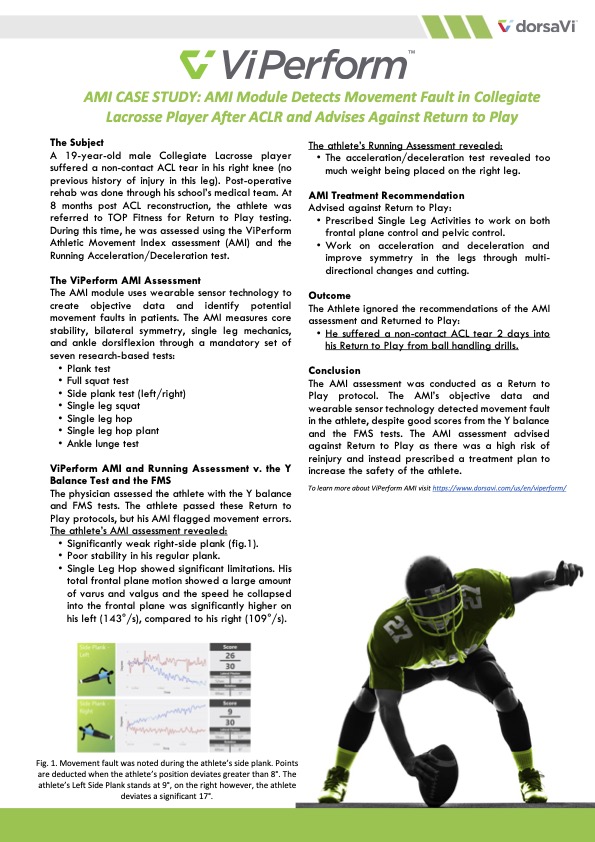
  We are very excited to share with you our new case study.  Here we discuss a return to play decision on a Collegiate Lacrosse player after an ACLR. By reading the case study posted below you can learn  how our AMI predicted injury potential in a Collegiate Lacrosse player during his Return to Play assessments.  More specifically, we will explain to you how the AMI Module and dorsaVi’s wearable sensor technology successfully detected movement fault on the athlete’s right side, eight months after ACL reconstruction surgery on his right knee. We walk you through the AMI module tests, data and results to explain how the module detected movement fault, why the AMI advised against return to play and the consequences of the athlete’s decision to continue to return to play.  We demonstrate how valuable the AMI module’s objective, actionable data is when assessing an athlete’s physical well-being: it is a crucial tool for injury prevention and creating safer return-to-...

Amazing Shane Benzie Webinar: Discussing Movement Analysis Out of the Lab and into the Natural World

Image
Shane Benzie Webinar Two of our dorsaVi team members, Dr Kerri Whitehead and Royston Barksby , sat down with Shane Benzie , a world-renowned running coach, movement specialist, and researcher.  Benzie’s work takes him to six continents and many different extreme environments where he coaches and analyzes athletes. His work includes living with tribes and indigenous people, focusing on natural human movement and how to turn it into human performance. He has authored an incredible, bestselling book: “The Lost Art of Running.”  In this webinar, we take the laboratory outside into the natural world by discussing movement analysis for a runner in a natural environment. Here, Shane will review a case study for his work with Rhonex Kipruto, the world record holder for the road 10k . He dives into the specific data analysis and study of the interaction with the ground and how it affects his dynamic movement.   This was an amazing webinar that we are excited to share wi...

Why Have These Tests Been Specifically Selected For The AMI Assessment?

  The AMI and The Tests The AMI module uses wearable sensor technology to create objective, actionable data and identify potential movement faults in patients. The AMI measures core stability, bilateral symmetry, single leg mechanics, and ankle dorsiflexion  through a mandatory set of seven research-based tests:  Plank test  Side plank test (left/right) Full squat test  Single leg squat  Single leg hop Single leg hop plant  Ankle lunge test But "why  have these tests been specifically selected for the AMI assessment?"  Time and time again, our dorsaVi sales team has been asked this question by countless interested customers.  To answer this question concisely , watch this quick five minute clip of Dr Trent Nessler , PT, MPT, DPT, and co-founder of the AMI, as he gives a detailed explanation as to how these seven tests came about, why they were selected and the importance of each when examining athletes well being.  

Interesting Research Article: Studying the Validity of Functional Performance Tests to Predict Knee Injury

Image
Poor Validity of Functional Performance Tests to Predict Knee Injury in Female Soccer Players With or Without Anterior Cruciate Ligament Reconstruction This research article, from the American Journal of Sports Medicine , investigates the poor validity of functional performance tests to predict knee injury in female soccer players with or without ACL reconstruction.  The study was conducted on a cohort of active female soccer players, 117 of which had ACL reconstructive surgery and 119 knee-healthy players:  At baseline, all players underwent tests to assess postural control (Star Excursion Balance Test), Hop performance (Single Leg Hop for Distance, Side Hop) and movement asymmetries in the lower limbs (Drop Vertical Jump, Tuck Jump). Then the predictive validity of the test cutoffs was assessed by identifying players who would sustain ACL injury or a severe traumatic knee injury. The study concludes that the validity of commonly used functional performance tests is...