Posts

Showing posts with the label ACL Injury Prevention

New Study: Assessing the Validity of the Triple Hop Distance as a Test for Return To Sports assessments

Symmetry in Triple Hop Distance Hides Asymmetries in Knee Function After ACL Reconstruction in Athletes at Return to Sports This research article, from The American Journal of Sports Medicine , evaluates the lower limb function of athletes after ACL reconstructive surgery and aims to question the effectiveness of the triple hop for distance test on athletes who have passed the return to sport (RTS) assessments. This study was done in a controlled laboratory study and conducted on 47 male athletes:  24 athletes had undergone ACLR and were cleared to RTS  The criteria for RTS was one of the following: (1) clearance by the surgeon and physical therapist (2) completion of a sports-specific on-field rehabilitation program (3) limb symmetry strength index <90% after quadriceps strength and hop battery tests.  23 athletes were healthy controls during the triple hop test.  From here, lower limb and trunk kinematics were calculated and evaluated using mixed linear models. ...

Why Did DorsaVi Create the AMI?

Why Did DorsaVi Create the AMI? On this blog, we have discussed: what the AMI is capable of, case studies and reviews from clients about this wearable sensor technology. However, we have yet to discuss how the AMI came to be created. Our Marketing & Sales team had the opportunity to sit down and talk with Dr. Trent Nessler, PT, MPT, DPT and the co-founder of the AMI to ask exactly "Why the AMI was built?" As a Physical Therapist, Doctor Trent Nessler was witnessing movement patterns detrimental to an athlete's movement, even after they had completed rehab. Interested in reducing this risk, he set about trying to find a way to better assess an athlete's recovery.  Watch the quick clip below to hear how Doctor Trent Nessler came to create the AMI: For more information on the AMI, check out some of our other blog posts:  Why Have These Tests Been Specifically Selected For the AMI Assessment? The TSK-11: The Importance Of Using Patient Reported Outcomes

Intepret and Relay the Results of the AMI: a great webinar for current users and new prospective users of the Athletic Movement Index

Interpret and Relay the Results of the AMI Join Trent Nessler, Shawna Jamison and Maka Lange as they discuss the specific tests and results of using the Athletic Movement Index (AM).  In this on-demand webinar, we discuss the specific tests and the results of the AMI along with the rationale behind some of the tests.  This webinar assists current users and informs prospective new clients on the AMI testing along with discussing the results of the AMI and how they translate into improving performance and preventing injury.  We take you through how to deliver results from the AMI to your athletes in a positive way sometimes on a potentially "not so positive test" as well as discussing interventions from the athlete.  Trent Nessler, Shawna Jamison and Maka Lange create positive phrasing and keywords for our users to take back for their next session.  In this webinar you will learn: How to deliver results from the AMI to your athletes in a positive way.  Ways t...

dorsaVi Interview with Mark Scarlato

Image
DorsaVi Interviews Mark Scarlato Our amazing team at dorsaVi had the opportunity to interview Mark Scarlato and ask him all about his experiences utilising dorsaVi wearable sensor technology at his clinic.  In this interview: Excitingly, Mark Scarlato also walks us through a case study he conducted with the dorsaVi technology.  we demonstrate how easy and effective the AMI module is for clinicians to utilise as a tool. We will also show you how valuable the AMI module is for assessing an athlete’s physical well-being: its actionable data is a crucial tool for creating, improving, and monitoring the success of an athlete’s training and physical therapy plan. Check out the full interview here!

Health Me Podcast: dorsaVi Discussing the AMI (Listen to the Podcast Here!)

Image
The Health Me Podcast hosted by Michael Swienton interviews Joanna Goldin from dorsaVi Recently our dosaVi Head of Clinical Sales, Joanna Goldin, PT, was invited to speak on the Health Me Podcast, hosted by Michael Swienton, DPT, CSCS. In the episode, they covered wearable sensor technology in the realm of performance and recovery especially related to the dorsaVi technology. dorsaVi has been the leader in the space for many years and Joanna was able to share everything she has experienced with the technology.  The podcast covered the following topics:  dorsaVi Origins  Sensor Technology in the realm of Physical Therapy  Clinical Use  Language and Communcation  Testing with dorsaVi Future of Wearable Technology  AND MUCH MORE... Listen to the Podcast Here! If you would like to learn more about the AMI and utilizing our amazing technology, watch our on-demand webinar here  and learn how the dorsaVi AMI Module can help your athlete on the road to ...

New Research Article: Rehabilitation and Return to Sport after Arthroscopic Treatment of FAI

Image
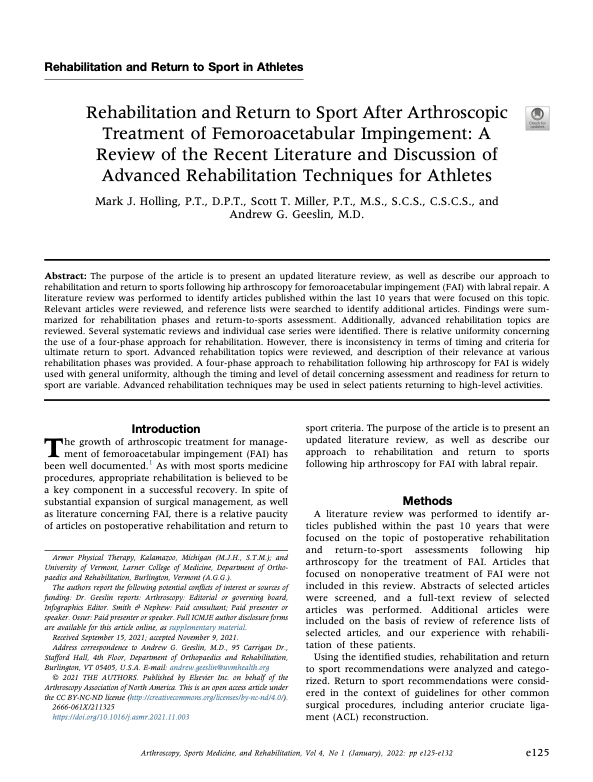
  Rehabilitation and Return to Sport After Arthroscopic Treatment of Femoroacetabular Impingement: A Review of the Recent Literature and Discussion of Advanced Rehabilitation Techniques for Athletes Published in Arthrosocopy, Sports Medicine and Rehabilitation, Vol 4, No 1, January 2022 Written by Mark Holling et al who is one of our excellent dorsaVi clients. The purpose of this article is to present an up to date literature review on the research in this area and to describe the approach to rehabilitation and return to sports following hip arthroscopy for femoroacetabular impingement (FAI) with labral repair. In order to create a comprehensive literature review, the article:  Pulls together articles that were published within the last 10 years, all of which focused on postoperative rehabilitation and return-to-sport assessments following hip arthroscopy for the treatment of FAI. Using these studies, rehabilitation and return to sport recommendations were then analy...

Fascinating Research Article: To Examine The Efficacy of a Neuromuscular Training Intervention on Acute Sports-Related Time-Loss Injury

  An 8-Week Neuromuscular Training Program After Concussion Reduces 1-Year Subsequent Injury Risk: A Randomized Clinical Trial This research article, taken from the American Journal of Sports Medicine , examines the efficacy of a neuromuscular training (NMT) intervention on acute sports-related time-loss injury over the subsequent year relative to standard of care.  The study was conducted through a randomized clinical trial, a total of 27 youth athletes were assessed initially postconcussion and then again after they received return-to-play clearance:  After return-to-play clearance, the athletes were then randomly assigned to either: NMT intervention (this consisted of 11 athletes) or standard of care (this consisted of 16 athletes.  Those sectioned into the NMT intervention completed guided strength exercises with landing stabilization focus 2x per week for a duration of 8 weeks. Standard of care received no recommendations.  Over the subsequent year, athlet...

Injury Prevention Case Study: Soccer program successes by instituting the AMI technology for injury prevention for their D1 Athletes

Image
    We are very excited to share with you our new case study.  Here we discuss the Grand Canyon University D1 women's soccer team utilisation of the dorsaVi's Athletic Movement Index (AMI).  By reading the case study posted below you can learn  how GCU's Physical Therapist and Athletic Trainer used the AMI to create tailored programs for their athletes as an injury prevention tool.  More specifically, we will explain to you how the AMI Module and dorsaVi’s wearable sensor technology successfully tested a series of athletes, from which detailed training programs were designed.  We walk you through the AMI module tests, data, and results and show you the positive outcome of dorsaVi testing and subsequent programmes by comparing the injury statistics.   We demonstrate how valuable the AMI module’s objective, actionable data is when assessing an athlete’s physical well-being: it is a crucial tool for injury prevention and creating safer retu...

Does Sport Specialization Increase Risk for Injury?

Image
Sport Specialization and the AMI Studies have shown that children who participate in sport have an improved quality of life. They are less likely to smoke or to be truant at school and are more likely to maintain good grades. With over 7.8 million kids participating in interscholastic sports each year, sports injuries are inevitable, and dorsaVi designed the Athletic Movement Index (AMI) with the goal to minimize that risk of injury where possible.  DorsaVi’s interest lies predominantly with injury prevention for the lower extremity, specifically knee and ACL injury. Why do we hold a strong focus here?  Ingram et al ( American Journal of Sports Medicine, 2008 ) study showed that the most reported athletic injury between the ages of 15 and 25 is a knee injury.  Fernandez et al ( American Journal of Sports Medicine, 2007 ) showed lower extremity injuries account for 60-70% of all injuries in high school athlete populations.  Rechel et at ( Journal of Trauma and Acute C...

The dorsaVi AMI v. Competitors: How do the AMI wearable sensors compare to what is on the market?

  The AMI v. Competitors At dorsaVi, we make wearable sensors. Our AMI module relies on easy to use wearable sensor technology: a clinician simply places these sensors on an athlete and conducts a series of seven tests to assess and record their movement. For our AMI module, wearable sensors are first placed on the low back in order to measure the movement of the lumbar spine. Whilst the sensors are on the low back, the athlete will complete:  One minute plank  20 full squats  One minute side plank (right and left)  The clinician will the switch the sensors from the low back to the tibia and continue the assessment with single limb testing:  Single leg squat  Single leg hop Single leg hop plant (hop forward, hop back, hop lateral, hop medial)  Ankle dorsiflexion  But, why do we rely on wearable technology when there is a vast range of other technologies out there? And   how does wearable technology compare with this?  Dr Trent ...

Important Case Study: Lacrosse player Returned to Play and reinjures ACL after failing AMI assessment

Image
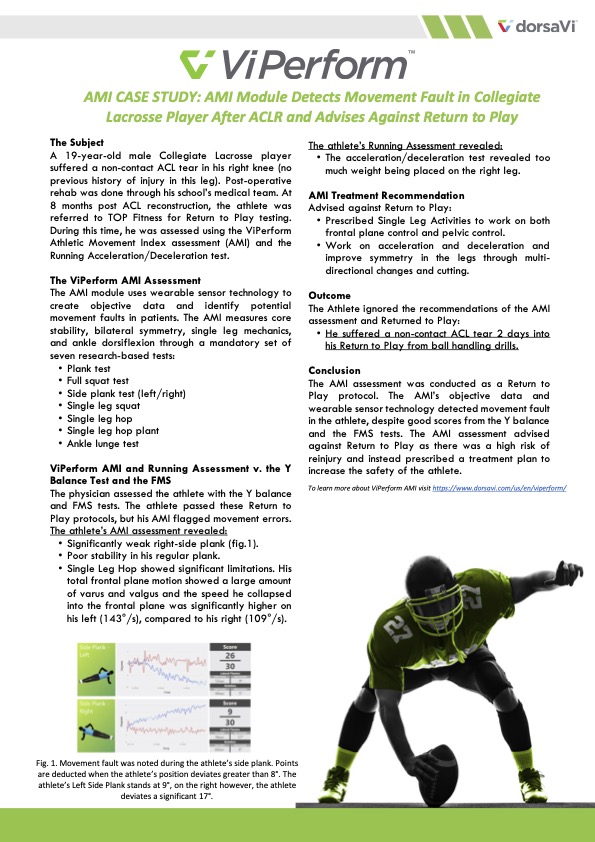
  We are very excited to share with you our new case study.  Here we discuss a return to play decision on a Collegiate Lacrosse player after an ACLR. By reading the case study posted below you can learn  how our AMI predicted injury potential in a Collegiate Lacrosse player during his Return to Play assessments.  More specifically, we will explain to you how the AMI Module and dorsaVi’s wearable sensor technology successfully detected movement fault on the athlete’s right side, eight months after ACL reconstruction surgery on his right knee. We walk you through the AMI module tests, data and results to explain how the module detected movement fault, why the AMI advised against return to play and the consequences of the athlete’s decision to continue to return to play.  We demonstrate how valuable the AMI module’s objective, actionable data is when assessing an athlete’s physical well-being: it is a crucial tool for injury prevention and creating safer return-to-...

Why Have These Tests Been Specifically Selected For The AMI Assessment?

  The AMI and The Tests The AMI module uses wearable sensor technology to create objective, actionable data and identify potential movement faults in patients. The AMI measures core stability, bilateral symmetry, single leg mechanics, and ankle dorsiflexion  through a mandatory set of seven research-based tests:  Plank test  Side plank test (left/right) Full squat test  Single leg squat  Single leg hop Single leg hop plant  Ankle lunge test But "why  have these tests been specifically selected for the AMI assessment?"  Time and time again, our dorsaVi sales team has been asked this question by countless interested customers.  To answer this question concisely , watch this quick five minute clip of Dr Trent Nessler , PT, MPT, DPT, and co-founder of the AMI, as he gives a detailed explanation as to how these seven tests came about, why they were selected and the importance of each when examining athletes well being.  

Interesting Research Article: Studying the Validity of Functional Performance Tests to Predict Knee Injury

Image
Poor Validity of Functional Performance Tests to Predict Knee Injury in Female Soccer Players With or Without Anterior Cruciate Ligament Reconstruction This research article, from the American Journal of Sports Medicine , investigates the poor validity of functional performance tests to predict knee injury in female soccer players with or without ACL reconstruction.  The study was conducted on a cohort of active female soccer players, 117 of which had ACL reconstructive surgery and 119 knee-healthy players:  At baseline, all players underwent tests to assess postural control (Star Excursion Balance Test), Hop performance (Single Leg Hop for Distance, Side Hop) and movement asymmetries in the lower limbs (Drop Vertical Jump, Tuck Jump). Then the predictive validity of the test cutoffs was assessed by identifying players who would sustain ACL injury or a severe traumatic knee injury. The study concludes that the validity of commonly used functional performance tests is...

Great Article from SportsEd TV: ACL Injuries in Volleyball

Image
  SportsEd TV and ACL Injuries in Volleyball SportsEd TV has uploaded two great articles discussing the increased risk for ACL injuries in volleyball players.  In the first article,  ACL Injuries in Volleyball  (click  here to read), SportsEdTV discuss certain factors which lead to an increase in injury to volleyball players, particularly in female athletes. The article also discusses how a coach could evaluate this risk in your players. The second article,  ACL Injuries in Volleyball – Part II  (click  here to read), continues from this article. This article investigates the question:      • Once you assess them, what do you do with that information?      • Is there a way to address this with training?      • By addressing this with training, will this mitigate their risk for injury? To tackle these questions, the article discusses a study documenting the positive outcome of dorsaVi wearable sensor t...

Great Research Article: Assessing the Effect of ACLR on Future Sports Participation, Patient Reported Outcomes and Physical Function

Image
Effect of Anterior Cruciate Ligament Rupture on Physical Activity, Sports Participation, Patient-Reported Health Outcomes, and Physical Function in Young Female Athletes This research article, from the American Journal of Sports Medicine , looks at the effect of ACL reconstruction on future sports participation, patient reported outcomes, and physical function in female athletes.  The study was conducted on a cohort of 102 female athletes aged 15-23, 51 participants had undergone ACL reconstruction within the previous 1-2 years and 51 had no previous knee injury:  All participants were fitted with an accelerometer for 13 days that measured their Physical Activity.  The participants completed patient-reported health outcomes: Tegner activity level, Knee Injury and Osteoarthritis Outcome Score (KOOS), Knee Self-Efficacy Sale (K-SES), Anterior Cruciate Ligament Return to Sport After Injury scale (ACLRSI), Tampa Scale for Kinesiophobia (TSK-11).  Physical function test: ...

The TSK-11: The importance using of Patient Reported Outcome for Return to Play decisions

The TSK-11 and Patient Reported Outcome Measures DorsaVi’s Athletic Movement Index (AMI) is an amazing tool for clinicians to make Return to Play decisions, but we hope to encourage our customers to increase the validity of their Return to Play assessments by utilizing Patient Reported Outcomes Measures (PROMs), specifically the Tampa Scale Kinesophobia-11 (TSK-11). What is the TSK-11? And why is this PROM so important in ACL Return to Play assessments?  The TSK-11 is a questionnaire designed to assess an athlete’s mental status after sustaining a lower extremity injury; primarily used in the ACL sphere, it also has some application with foot, ankle and hip injuries (click  here to check out the TSK-11 questionnaire). Ultimately,  the TSK-11 assesses the athlete’s fear to bear weight and trust their previously injured limb . For example, if an athlete sustains an ACL injury and has reconstructive surgery on his right leg, they are likely fearful of cutting right and weig...

Concussion and Return to Play: Does concussion affect lower extremity injuries in athletes?

The AMI and Concussion  In a recent webinar with Dr Trent Nessler, PT, MPT, DPT and co-founder of the AMI (Athletic Movement Index) our dorsaVi team were keen to ask him about the significance of the AMI results in relation to a previous concussion and how concussion can relate to an athletes future health and movement.  Whilst investigating the relationship between concussion and movement, Dr Nessler started to see some interesting things as a pattern began to emerge:  Those who reported a previous concussion also reported more lower kinetic chain injuries. Those who had a previous history of concussion had poor motion and scored poorly on the AMI.  This is supported by the research: Those who had reported a concussion were 3 times more likely to suffer a lower kinetic injury. ( Frances Gilbert et al, Sports Health, 2016 )  This is why assessments, such as the dorsaVi Athletic Movement Index (AMI), are so important. Research indicates a relationship b...