Posts

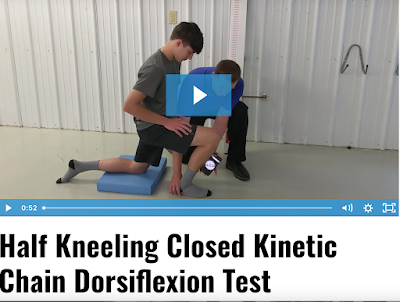
Looking At Ankle Dorsiflexion: Half Kneeling Closed Kinetic Chain Dorsiflexion Test
Image
Half-Kneeling Closed Kinetic Chain Dorsiflexion Test Ankle Dorsiflexion is a crucial test for the Athletic Movement Index (AMI), this is because DorsaVi recognizes that when testing an athlete's lower extremities, the clinician is looking at the entire kinetic chain.  Previously, on this blog, we have shared our explanation as to  Why Is Ankle Dorsiflexion A Metric On The AMI?  Now we are following this article with a great post from Phil Plishy about the importance of the  Half-Kneeling Closed Kinetic Chain Dorsiflexion Test . Importantly, the post makes reference to how ankle sprains are one of the most prevalent lower extremity injuries in athletes. It goes on to explain how the open-chain position has been the most conventional assessment for Ankle Dorsiflexion but questions the reliability of this method.

Check Out Our Webinar with Dr. Seun Adigun: How to Assess Pre and Post Treatment Interventions with dorsaVi Technology

Image
Webinar with Dr. Seun Adigun on how to Assess Pre and Post Treatment Intervention with DorsaVi Technology Our team had the opportunity to talk with Dr. Seun Adigun DC, owner of the Extra Wellness Center, to discuss the ways she utilizes dorsaVi technology as an assessment tool before and after therapeutic interventions.  To aid this discussion Dr. Seun Adigun references a fascinating case study about a Professional football player. For this study, dorsaVi's wearable sensor technology and the Hamstring module were used to assess the athlete prior to treatment. It was then used again post-intervention. In this webinar, Dr. Seun Adigun discusses the results and then further analyzes the compensation patterns exhibited by the athlete and the plan for treatment. DorsaVi's wearable sensor technology is an excellent tool for the assessment of an athlete pre and post-intervention of any type.  Click here to check out this great case study and learn some great clinical pearls!  F...

Check Out This Study: Lumbopelvic Postural Differences in Adolescent Idiopathic Scoliosis

Image
Lumbopelvic Postural Differences in Adolescent Idiopathic Scoliosis: A Pilot Study This study, from Gait & Posture , conducted by Matthew Jamison et al noted the currently unknown primary etiology of adolescent idiopathic scoliosis (AIS), but poor postural control of the spinal extensor musculature has been identified as an AIS risk factor.  The objective of this study was to answer the question "are there any determinable differences in lumbopelvic posture of range of motion between subjects with AIS and controls?" by using the ViMove dorsaVi sensor package .  This study consisted of 53 subjects aged between 11 and 17 years old:  27 of the subjects had AIS.  26 of the subjects were control.  All the subjects underwent a live assessment in order to understand the initial lumbopelvic (LP) range of motion (ROM) measurement. They were then monitored while completing normal activities of daily living (ADLs) for 12 hours. Finally, with an alpha level of 0.05, non...

Intepret and Relay the Results of the AMI: a great webinar for current users and new prospective users of the Athletic Movement Index

Interpret and Relay the Results of the AMI Join Trent Nessler, Shawna Jamison and Maka Lange as they discuss the specific tests and results of using the Athletic Movement Index (AM).  In this on-demand webinar, we discuss the specific tests and the results of the AMI along with the rationale behind some of the tests.  This webinar assists current users and informs prospective new clients on the AMI testing along with discussing the results of the AMI and how they translate into improving performance and preventing injury.  We take you through how to deliver results from the AMI to your athletes in a positive way sometimes on a potentially "not so positive test" as well as discussing interventions from the athlete.  Trent Nessler, Shawna Jamison and Maka Lange create positive phrasing and keywords for our users to take back for their next session.  In this webinar you will learn: How to deliver results from the AMI to your athletes in a positive way.  Ways t...

dorsaVi Interview with Mark Scarlato

Image
DorsaVi Interviews Mark Scarlato Our amazing team at dorsaVi had the opportunity to interview Mark Scarlato and ask him all about his experiences utilising dorsaVi wearable sensor technology at his clinic.  In this interview: Excitingly, Mark Scarlato also walks us through a case study he conducted with the dorsaVi technology.  we demonstrate how easy and effective the AMI module is for clinicians to utilise as a tool. We will also show you how valuable the AMI module is for assessing an athlete’s physical well-being: its actionable data is a crucial tool for creating, improving, and monitoring the success of an athlete’s training and physical therapy plan. Check out the full interview here!

Health Me Podcast: dorsaVi Discussing the AMI (Listen to the Podcast Here!)

Image
The Health Me Podcast hosted by Michael Swienton interviews Joanna Goldin from dorsaVi Recently our dosaVi Head of Clinical Sales, Joanna Goldin, PT, was invited to speak on the Health Me Podcast, hosted by Michael Swienton, DPT, CSCS. In the episode, they covered wearable sensor technology in the realm of performance and recovery especially related to the dorsaVi technology. dorsaVi has been the leader in the space for many years and Joanna was able to share everything she has experienced with the technology.  The podcast covered the following topics:  dorsaVi Origins  Sensor Technology in the realm of Physical Therapy  Clinical Use  Language and Communcation  Testing with dorsaVi Future of Wearable Technology  AND MUCH MORE... Listen to the Podcast Here! If you would like to learn more about the AMI and utilizing our amazing technology, watch our on-demand webinar here  and learn how the dorsaVi AMI Module can help your athlete on the road to ...

New Case Study: Young Baseball Catcher with Low Back Pain

Image
We are very excited to share with you  our new AMI case study .  Scroll down to read all about  how DorsaVi’s AMI Module was used to help explain the back pain of a baseball athlete and create a treatment plan to help relieve the plan. The brochure will explain how DorsaVi’s AMI Module and wearable sensor technology was used to assess the athlete’s movements, explain the presence of low back pain, and how it is attributed to certain repetitive manoeuvres of an athlete in the sport of baseball.  We will walk you through the results of the athlete’s AMI assessment and explain how the AMI data and results were used to create a pain-free physical therapy regime and subsequently improve his performance in baseball. In this case study, we demonstrate how easy and effective the AMI module is for clinicians to utilise as a tool. It also shows how valuable the AMI module is for assessing an athlete’s physical well-being: its actionable data is a crucial tool for creating, imp...